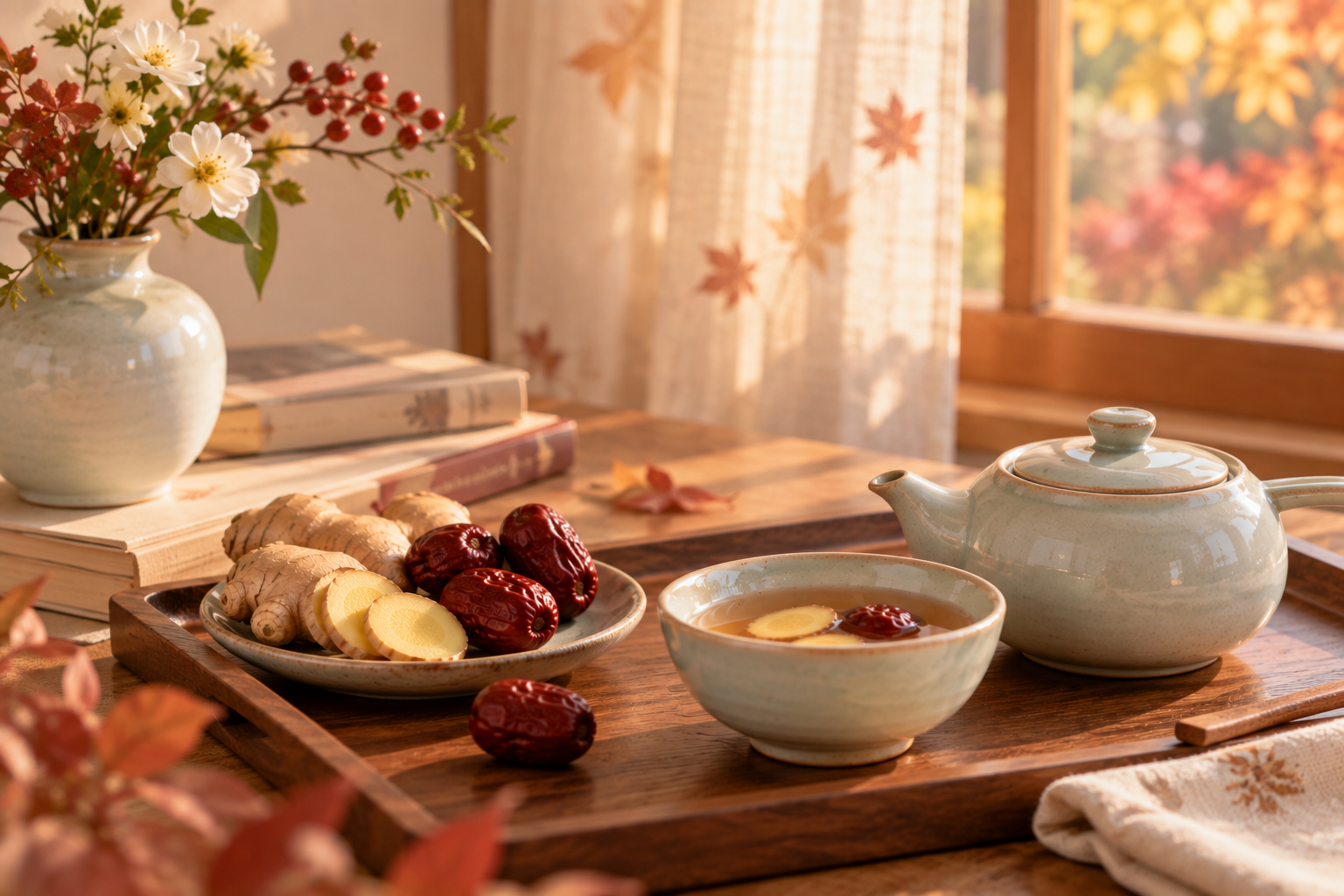
Does Ginger & Jujube Tea Really Warm Your Body? What Traditional Medicine and Modern Research Say
When the weather starts to turn cooler, a warm cup of tea can feel especially comforting.
In Korea, ginger tea has traditionally been enjoyed when people feel chilled, have a scratchy throat, or simply feel under the weather. Many people also have memories of making ginger tea at home when someone in the family was feeling unwell.
Among these traditional drinks, ginger and jujube tea is a simple combination that has been enjoyed in Korea for generations.
The spicy, aromatic flavor of ginger pairs naturally with the mild sweetness of jujube, making it a comforting drink for cooler seasons.
But there is an interesting question behind this familiar tradition:
Does ginger and jujube tea really warm the body? And is there scientific evidence behind the ways ginger and jujube have traditionally been used?
Traditionally, both ginger and jujube have been described as ingredients with a “warming” nature. But is this traditional concept of warmth the same thing as an actual change in body temperature measured by modern science?
In this article, we’ll look at ginger and jujube from three perspectives: traditional use, nutritional characteristics, and current scientific research.
What Is Ginger & Jujube Tea?
Ginger and jujube tea is a simple drink made by simmering dried jujubes and fresh ginger in water.
The jujubes release a naturally sweet flavor, while the ginger adds its characteristic spicy aroma and taste. Honey can also be added if you prefer a sweeter drink.
It requires only a few ingredients and is easy to prepare at home.
Most of all, it is a comforting tea that naturally fits the cooler seasons.
Ginger and Jujube in Korean Tradition
Ginger and jujube have been used for a long time in traditional Korean food culture and traditional medicine.
Historical Korean medical texts, including Hyangyak Jipseongbang (1433) and Donguibogam (1613), contain records of ginger and jujube being used in various traditional preparations and foods.
The two ingredients have also been used together with other medicinal herbs in traditional formulas.
However, an important distinction should be made:
The fact that an ingredient was traditionally used for a particular purpose does not mean that the same effect has been established by modern medical research.
For this reason, traditional descriptions of ginger and jujube should be considered separately from findings from modern scientific studies.
What Does the “Warming Nature” of Ginger and Jujube Mean?
In traditional Korean medicine, foods and medicinal herbs were classified according to various characteristics.
Ginger and jujube have traditionally been described as having a warming nature, or “온(溫).”
However, the traditional concept of “warming” is not the same as core body temperature, which is measured in modern physiology.
In other words:
Being traditionally described as “warming” is not the same as actually raising body temperature.
This distinction is important. Traditional classifications should be understood within the medical framework of their time rather than being directly equated with measurable changes in human physiology.
What Nutrients and Compounds Are Found in Ginger and Jujube?
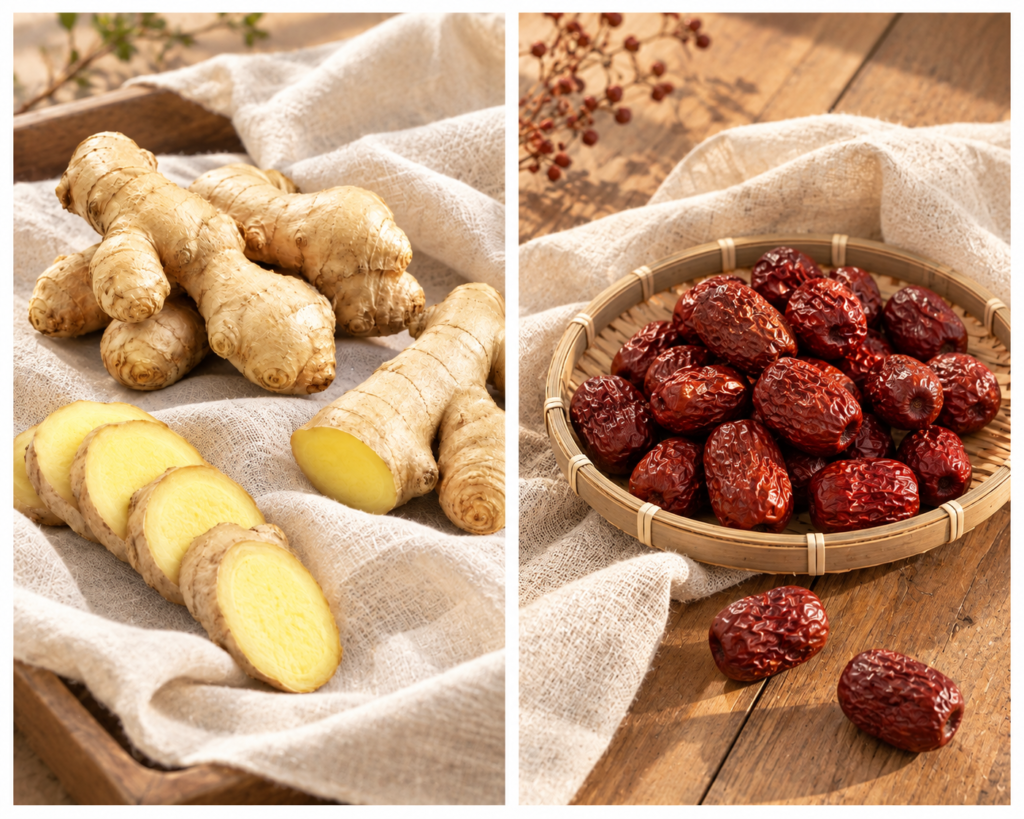
Ginger
Ginger contains carbohydrates, dietary fiber, and other nutrients.
Its characteristic spicy flavor and aroma are associated with bioactive compounds such as gingerols and shogaols.
According to USDA food data, 100 grams of raw ginger contains approximately 80 calories, along with carbohydrates and dietary fiber.
However, these numbers should not be applied directly to a cup of ginger and jujube tea. The amount of ginger used to prepare a cup of tea is very different from 100 grams.
So drinking ginger tea should not be interpreted as consuming large amounts of these nutrients.
Jujube
Jujubes contain natural sugars, carbohydrates, dietary fiber, and various plant compounds.
Researchers have shown interest in compounds found in jujube, including polyphenols, flavonoids, and polysaccharides.
As with ginger, the amount of these compounds actually consumed can vary depending on how much jujube is used and how the tea is prepared.
Does Ginger & Jujube Tea Really Warm Your Body?
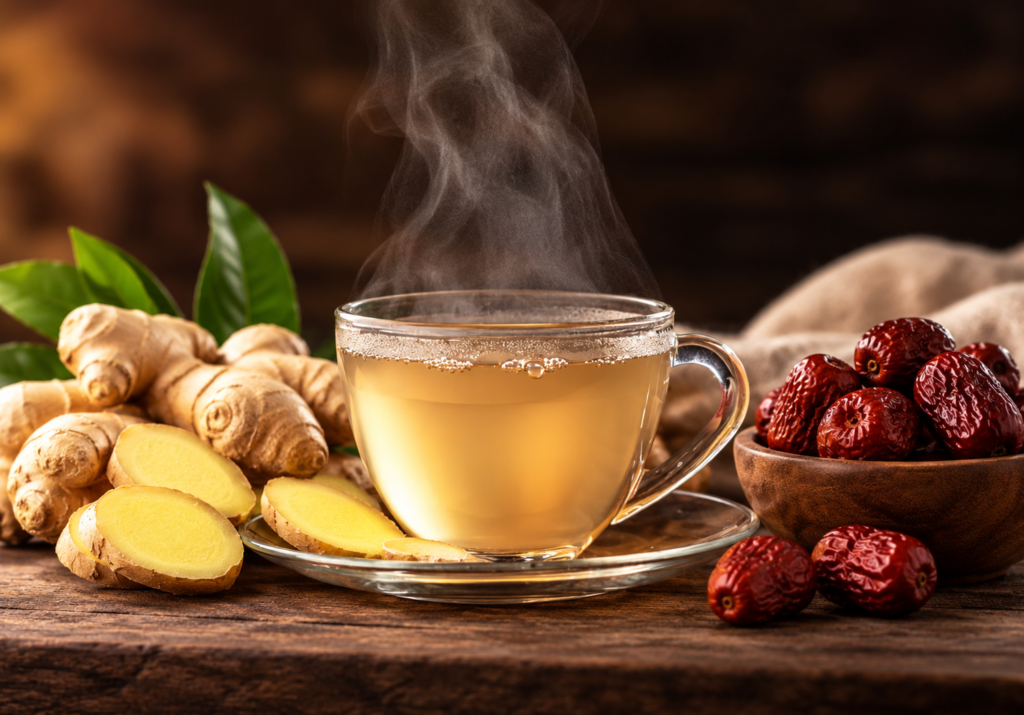
Many people experience a warm sensation after drinking ginger tea.
The warmth of the drink itself, together with the characteristic aroma and sensation of ginger, may contribute to this feeling.
But there is an important distinction:
Feeling warm is not the same as an actual increase in core body temperature.
Some studies have examined whether ginger consumption affects peripheral skin temperature. A 2005 Japanese study reported that consuming ginger was associated with significantly higher forehead skin temperature compared with water consumption. The study also observed changes in peripheral temperature after consuming ginger-containing bread.
Another Japanese study published in 2018 compared a ginger-extract beverage with a placebo beverage in six healthy women who reported cold hands and feet. After drinking the ginger beverage, palm surface temperature increased and remained elevated longer than in the placebo group.
However, this study had a very small sample size of only six participants. In addition, it measured surface temperature of the palm rather than core body temperature. Therefore, the findings should not be interpreted as evidence that ginger generally raises core body temperature.
In other words, peripheral skin temperature, core body temperature, and energy expenditure are different measurements, and changes in one do not necessarily mean changes in the others.
Based on the current evidence, the most cautious conclusion is:
Ginger and jujube tea may make you feel warm, but there is not enough evidence to conclude that it raises core body temperature.
What Benefits of Ginger Have Been Studied?
Beyond the question of warmth, what does modern research say about ginger itself?
Two compounds that have received particular attention are gingerols and shogaols.
Researchers have investigated ginger and its compounds in relation to digestion, nausea, oxidative stress, and inflammatory pathways.
Among these areas, nausea and vomiting have been studied in a relatively substantial number of human clinical studies.
A 2019 overview of systematic reviews published in Complementary Therapies in Medicine examined 27 systematic reviews and meta-analyses evaluating ginger for various conditions. Nausea and vomiting were the condition most frequently studied, accounting for 12 of the 27 reviews.
The authors concluded that many reviews showed promising results for ginger in relation to nausea and vomiting, metabolic syndrome, and pain, but noted that the quality of the underlying evidence was inconsistent and that better-designed studies were still needed.
This distinction is important.
A study using whole ginger, a study using an isolated ginger compound, and a study using a concentrated ginger supplement are not necessarily equivalent to drinking a cup of ginger tea.
Therefore, rather than saying “ginger tea provides these benefits,” it is more accurate to say that ginger and its compounds have been studied in these areas, with some of the more substantial human research focusing on nausea and vomiting.
What Does Modern Research Say About Jujube?
Jujube is also being studied for its various plant compounds.
Polyphenols, flavonoids, and polysaccharides found in jujube have been investigated in relation to antioxidant activity and other biological effects.
Jujube has also traditionally been used in contexts associated with relaxation and sleep.
However, traditional use or laboratory findings do not establish that jujube tea improves sleep or treats stress.
Studies conducted in cells or animals also provide a different level of evidence from studies involving human participants.
Therefore, when looking at research on jujube, it is important to consider what was studied, how the jujube was prepared, and whether the research involved humans, animals, or laboratory models.
What Happens When Ginger and Jujube Are Used Together?
There has also been research into the combination of ginger and jujube.
A 2021 study published in RSC Advances investigated jujube polysaccharides and 6-gingerol, a major bioactive compound from ginger, individually and in combination.
The researchers evaluated their antioxidant activity (DPPH radical scavenging) and their effects on human colon cancer cells (SW620), and found that the combination showed synergistic interactions in both the antioxidant tests and the cell-based experiments.
However, there is an important limitation:
This was not a clinical trial in which people drank ginger and jujube tea.
The researchers used isolated, purified jujube polysaccharides and 6-gingerol in laboratory and cell-based experiments.
Therefore, the results cannot be directly interpreted as proof that drinking ginger and jujube tea produces the same effects in humans.
The current evidence can be summarized as follows:
- Gingerols, shogaols, and other ginger compounds: Many studies have investigated these compounds.
- Ginger and nausea/vomiting: Multiple systematic reviews and human clinical studies have examined this area.
- Jujube polyphenols, flavonoids, and polysaccharides: Many laboratory studies have investigated these compounds.
- Ginger and jujube combination: One laboratory and cell-based study has reported synergistic antioxidant effects.
- Specific health effects of ginger and jujube tea itself: Direct clinical evidence remains limited.
For now, it is most accurate to describe the combination as an area with interesting early research, rather than as a proven health treatment.
How to Make Simple Ginger & Jujube Tea at Home
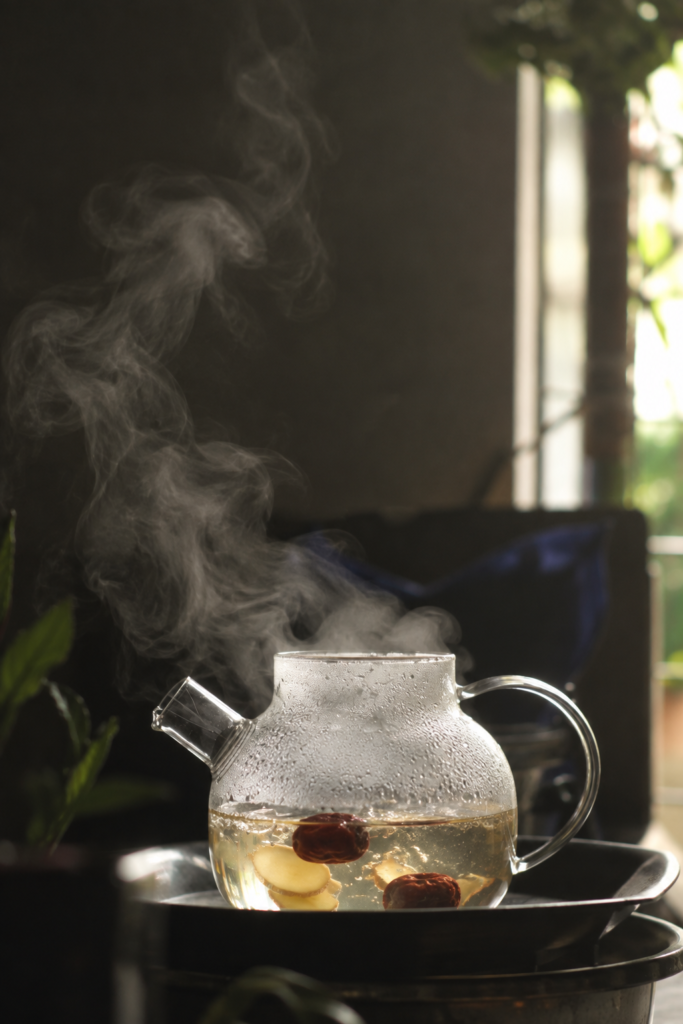
Ingredients
- 10–15 dried jujubes
- About 30–40 g fresh ginger
- 1–1.2 L water
- Honey, optional
Directions
- Wash the jujubes thoroughly.
- Wash the ginger and slice it thinly.
- Place the jujubes, ginger, and water in a pot.
- Bring to a boil, then reduce the heat and simmer gently for about 30–40 minutes.
- Strain the tea and pour into a cup.
- If desired, add honey after the tea has cooled slightly.
Adjust the Ginger and Jujube to Your Taste
The amount of ginger and jujube does not have to be fixed.
More ginger will give the tea a stronger, spicier flavor, while more jujube will add natural sweetness.
The amounts above are simply a starting point. You can adjust the ratio according to your personal preference.
If you do not enjoy a strong ginger flavor, try using a little less ginger and adding more jujube. Honey is also completely optional.
Tip: Ginger and jujube tea does not have one “correct” recipe. Adjusting the balance of ginger and jujube is part of making the tea your own.
When Is the Best Time to Drink Ginger & Jujube Tea?
There is not enough scientific evidence to say that ginger and jujube tea must be consumed at a particular time of day.
You can enjoy it in the morning or afternoon, or simply have it as a warm drink on a cool day.
However, ginger can cause heartburn or digestive discomfort in some people. If you have experienced these effects, adjust the amount and timing according to how your body responds.
Ultimately, the most important thing is finding a time and amount that feels comfortable for you.
What Can You Expect From Ginger & Jujube Tea?
Based on the research available today, ginger and jujube can be understood in the following way.
Ginger
- Contains bioactive compounds such as gingerols and shogaols
- Has human research support in relation to nausea and vomiting
- Is being investigated for antioxidant and anti-inflammatory pathways
Jujube
- Contains various plant compounds, including polyphenols and flavonoids
- Contains polysaccharides that have been studied in laboratory research
- Has been traditionally used in foods and teas
Ginger + Jujube
- The combination of compounds from the two ingredients has been investigated in an early laboratory and cell-based study
- However, direct clinical evidence for specific health effects of ginger and jujube tea itself remains limited
For this reason, it is more appropriate to think of ginger and jujube tea as a warm beverage made from familiar plant-based ingredients, rather than as a drink that treats disease.
Things to Keep in Mind When Drinking Ginger & Jujube Tea
Ginger and jujube tea is made from common food ingredients, but drinking more does not necessarily mean greater health benefits.
A few things are worth keeping in mind:
- Consuming large amounts of ginger may cause heartburn or digestive discomfort in some people.
- Jujubes naturally contain sugars.
- Adding honey or sugar increases the overall sugar content of the drink.
- Regular ginger tea and concentrated ginger extracts or supplements are not equivalent in dose or concentration.
- If you have a medical condition or take medications, consider speaking with a healthcare professional before using concentrated ginger products.
Tradition and Modern Science: How Should We Look at Them Together?

The traditional and modern perspectives can be understood without treating them as the same thing.
Traditional perspective
- Ginger and jujube are traditionally described as having a warming nature.
- They have been used for generations in foods and traditional preparations.
- They are enjoyed together as a warm drink.
- Ginger and jujube have also been used together in traditional preparations.
Modern scientific perspective
- “Warming nature” is not the same as a measurable change in body temperature.
- Researchers are studying various compounds found in ginger and jujube.
- Evidence for specific health effects varies depending on the topic and type of study.
- The ginger and jujube combination has been investigated in early laboratory studies.
- Traditional use should be distinguished from modern clinical evidence.
A Warm Cup, but Not a Miracle Drink
Ginger and jujube tea is a traditional drink that requires only a few ingredients and naturally fits the cooler seasons.
The spicy aroma of ginger and the gentle sweetness of jujube complement each other, making a warm cup an enjoyable part of everyday life.
Modern research has also drawn attention to the various bioactive compounds found in ginger and jujube.
But laboratory findings or research on individual compounds should not automatically be interpreted as evidence of the same health effects from a cup of ginger and jujube tea.
Tradition can be appreciated as tradition, while scientific research can be understood within the limits of what the evidence actually shows.
Perhaps that is one of the best ways to enjoy traditional foods and drinks through a modern perspective.
Frequently Asked Questions
Does ginger and jujube tea raise body temperature?
A warm drink can make you feel warmer, but ginger and jujube tea has not been shown to consistently raise core body temperature in humans.
Some studies have observed changes in peripheral skin temperature after ginger consumption, but these findings should not be equated with a sustained increase in core body temperature.
What benefits of ginger have been studied?
Ginger contains bioactive compounds such as gingerols and shogaols, and human research has investigated ginger particularly in relation to nausea and vomiting.
However, studies differ in the type and dose of ginger used, so the results cannot automatically be applied to a cup of ginger tea.
Can I drink ginger and jujube tea every day?
A tea made from ordinary food ingredients can be enjoyed as part of an individual’s diet and preferences.
However, drinking more does not necessarily provide greater health benefits, and some people may experience heartburn or digestive discomfort from ginger.
Does ginger and jujube tea help with sleep?
Jujube has traditionally been used in contexts associated with relaxation and sleep, but there is limited clinical evidence demonstrating that ginger and jujube tea itself improves sleep.
Can ginger and jujube tea treat health problems?
Ginger and jujube tea is a beverage made from food ingredients, not a medicine intended to treat disease.
If you have a specific health concern, appropriate medical advice is important.
Final Thoughts
Rather than thinking of ginger and jujube tea as a treatment drink that “heats” the body, it may be more useful to see it as a traditional way of enjoying two familiar ingredients in a warm cup of tea.
Modern science gives us new questions to ask about this old tradition.
When we feel warm after drinking ginger tea, is our body temperature actually changing—or are we experiencing the warmth of the drink and the characteristic sensation of ginger?
Current research offers some interesting clues, but it has not established all of the health effects of ginger and jujube tea itself.
So this fall, rather than expecting a miracle from a cup of tea, why not adjust the amount of ginger and jujube to your own taste and simply enjoy a warm cup slowly?
References
- Fujisawa, F., Nadamoto, T., & Fushiki, T. (2005). Effect of Intake of Ginger on Peripheral Body Temperature. Journal of the Japanese Society of Nutrition and Food Science, 58(1), 3–9.
- Sugimoto, K., Takeuchi, H., Nakagawa, K., & Matsuoka, Y. (2018). Hyperthermic Effect of Ginger (Zingiber officinale) Extract-Containing Beverage on Peripheral Skin Surface Temperature in Women. Evidence-Based Complementary and Alternative Medicine, 2018.
- Li, H., Liu, Y., Luo, D., Ma, Y., Zhang, J., Li, M., Yao, L., Shi, X., Liu, X., & Yang, K. (2019). Ginger for health care: An overview of systematic reviews. Complementary Therapies in Medicine, 45, 114–123.
- Wu, Z., Gao, R., Li, H., Wang, Y., Luo, Y., Zou, J., Zhao, B., & Chen, S. (2021). New insight into the joint significance of dietary jujube polysaccharides and 6-gingerol in antioxidant and antitumor activities. RSC Advances, 11(53), 33219–33234.
- USDA FoodData Central. Ginger, raw.
- Hyangyak Jipseongbang (1433) and Donguibogam (1613), traditional Korean medical sources.